 #1
#1
There is "gold in them hills"
Amazon reported it made 1bn profit through price optimisation.
The good news is it works. The bad news is not many retailers are looking at their own pricing methods and strategies and optimising them. Something we do very well.

 #2
#2
Choking
I heard this phrase recently If you are not careful, the tail of stock
will choke your open-to-buy
Apparently, that is how most retailers go bust. The last 20 years of low interest rates might have made us lazy when it comes to stock management.
As the cost of capital has gone up 10- fold this year, optimising stock is essential. We need to be careful!
 #3
#3
Too much product
in the world
Between 1995-2010 world manufacturing capacity tripled. Capital (Foreign Direct Investment) poured into the emerging markets (the third world). It has helped keep inflation low.
If you search on Amazon for dresses you get 19,000. There is too much product out there.
Retailers cannot compete on product alone.
 #4
#4
Its only going to get
more expensive
We went from European manufacturing to Eastern Europe, to Turkey, to north Africa to Sri Lanka, to China, to India, to Vietnam, to Cambodia, and finally we have ended up in Bangladesh. That appears to be the end of the line.
It cannot get any cheaper. With living standards increasing everywhere, it can only get more expensive.
 #5
#5
The lost art of merchandising
The UK used to be a leader in
merchandising, like many things in Britain
we celebrate the things we have lost.
In a digital age encompassing the concept of fast retailing, it appears that people think planning has no value. We are losing merchandising skills.
In the military they always reminded people of the 7 Ps. Proper Planning and Preparation Prevents Piss Poor Performance
So true in retail.
 #6
#6
Merchandise well and your customers will come.
Sir Ralph Halpern once told me - that
was the philosophy of Burton Group
which he founded in the 1970s.
Its still true, but not if when they come they
get bad service and a poor customer experience.
In a customer centric world, a great product assortment needs to be accompanied by great customer service and experience.
 #7
#7
Customer engagement.
Its hard toretain the loyalty of customers
without really engaging with them.
Observations from retailers are - if your customers dont shop 4-12 times a year it is hard to engage with them.
Retailers need to have an assortment or product range that allows customers to shop 4-12 times a year, so digital or face to face engagement can really happen.
Not many do.
 #8
#8
Unified retailing.
Retailers are playing two roles today.
They have always been product distributors, and
more and more they are having to be curators on behalf of their customers.
That is why we are all talking about Unified retailing being customer centric and product centric concurrently, which is hard to do.
Whats more, as you gather more customer data, it should allow you to shape/improve your product assortment. But is it?
 #9
#9
Secret of a retailers
success
Charles Wilson once said: Most retailers have something unique in their DNA. Its what makes
them special.
My Advice is - if you have a best kept secret keep it that way. Dont lose sight of your DNA.
Charles also said, in his experience, retailers who stop performing are those that try and veer away from their original DNA.
Remember your competitive advantages is your competitive advantage, keep building on it.
 #10
#10
Structure vs Strategy –
what
is more important
in retailing
Business schools go on and on about
strategy. But real competitive advantage
often comes from Structure.
Look at natural species. They are different
because their DNA (structure) is different.
Anybody can copy your strategy, but few people can
re-create your unique DNA.
Structure is processes, systems, capabilities and
know-how.
 #11
#11
Retailers are still
organised
functionally!
There is a head of stores, head of
e-commerce, head of marketing,
head of B2B, head of supply chain,
head of buying, head of merchandising,
head of finance etc.
A focus on functional excellence is a paradise for those selling best of breed solutions.
I asked a CEO recently, Who in your organisation is in charge of end-to-end processes? He said, no one!
Unified Retailing is joined up retailing, from the consumer to the supplier & optimised. To be a high performing retailer you need excellent end-to-end processes
 #12
#12
Retailers are run
by people.
There is a lot of focus on AI, superior intelligence. But intelligence has to be acted on. People are part of the value chain.
There is no point putting in sophisticated intelligent systems if you have poorly trained people, that cannot act on it.
For every 1 you spend on systems, how much should you spend on the training and development of people, 25p-50p-1?
 #13
#13
Return of the Jedi!
If you equate the Empire as Amazon,
Online Sites, Facebook and Google.
The Jedi as local/national store-based retailers.
Recently, financial results show a Return of The Jedi
Will it last?
Unified business models that promote real omni-channel excellence are winning the war.
 #14
#14
Like for Like Sales
A retailer said to me that the only thing that matters is sales. I am measured on like-for-like sales growth.
Its easy to drive sales growth if you are not interested in making profits.
Just look at so many online retailers!
Like-for-like profits growth is much harder to achieve.
Unified retailers are the most profitable retailers.
 #15
#15
Whats the right
profitability level?
Many good retailers operate in the range of 5-10%
net profit.
Yet some break the 10% barrier-How do they do that?!
Could your business do that?
We believe its possible to double profits if you UNIFY
your business.
 #16
#16
GMROI
I am told that GMROI is the only KPI, private
equity firms who own retailers focus on.
If you dont know why. There are probably huge opportunities to create value in your business.
Stock Management is completely changing. You no
longer have to own the stock you sell.
It is possible to optimise inventory and space in an
omni-channel world, dramatically improving GMROI.
 #17
#17
Show me the money
A retail CEO who I was trying to sell a technology
solution to, said to me,
If I add up all the benefit cases I was sold by
consultants and IT vendors like you. My profits would
be double my revenue.
Its easy to imagine value. Much more difficult to
create it.
Of course we believe Unifying your business will create value.
 #18
#18
Whats the point
of a retailer
Amazon has shown you can digitally
connect a consumer to a supplier
seamlessly, without any human
contact. Its fast and convenient.
So whats the point of a retailer that is only a product distributor something to really think about?
There are all sorts of possibilities like, being a global brand, being a customer curator, making human
contact count, being part of a community, service and
convenience there needs to be a clear sense of
purpose, a differentiator. Unified retailing is all about
establishing a purpose.
 #19
#19
Why bother having
stores
In a national retailer, 85% of customers
live within 15 minutes of a store.
Your store is a point of community
engagement.
If you close a store, you lose out on a community and
your online sales from that community will also
decline. The reverse is also true.
The store is a focus and a point of community
engagement and not just a point of sale, but a point of
service. We believe CRM should be store driven.
You can make human contact count, by providing
services that make you more convenient than Amazon.
 #20
#20
15 Minute City
During covid we realised that being
close to services made a difference.
As we move to an eco-friendly world, having your store within 15 minutes of your customers will become a key competitive advantage.
Delivering from your shop will be cheaper, eco-friendly and more convenient than delivering from a national warehouse.
 #21
#21
Retailers want
to be national
and
international but isnt
it
all about the customer?
In the desire for growth, retailers
want to expand, naturally!
Ironically the fastest way to
grow is to grow locally.
It is easier to grow your
customer base by better engaging with your local community, around your store.
The fastest and most profitable growth comes from being more local.
Its not intuitive!
Unified retailing is customer centric retailing. What matters, is not market share, but the share of your community you have.
 #22
#22
Making human
contact count
Some people think CRM is about
email marketing from head office.
They forget that the R in CRM
stands for Relationships.
A relationship is really person
to person.
In the Godfather the famous line was, its business, its
not personal. Relationships unfortunately are personal.
You have staff in stores. Go make human contact count.
 #23
#23
VIP Programs
In most retail brands 10% of
customers
account for 40% of sales. These are
your VIP customers.
Getting VIP customers to shop 20% more,
doubles your profits.
You lose them at your peril. You need to keep reaching out to them and engaging with them.
 #24
#24
Retaining loyalty
A Harvard professor once
told me,
Price says more
about a brand
than any other
factor
You retain the loyalty of your customers
through the value and quality they
perceive in your products, your services,
and the experience of the engagement.
Be careful about discounting your brand.
 #25
#25
Too many Directors
in Retailing?
In most retailers you have
- A Retail Ops Director
- An e-commerce Director
- A Marketing Director
- A Customer (Services ) Director
But who is accountable for the customer relationship? Who owns the customer?
Who is responsible for the R in cRm?
Justin King; when he took over as CEO of Sainsbury, once said to me regarding his board.
I have the representative of my Shareholders, my non-execs and my CFO.
I have the representatives of my Employees, my HR director.
I have the representative of my Suppliers, my Buying director.
But I had no representative of my Customers?
So he spent 3 months in stores talking to them. He absolutely believed, as does Jeff Bezos, you cannot design a modern retailing business, except through the eyes of your customers.
if you have the same conundrum today, please talk to us. Unified retailing, if it is anything, needs to be customer centric. And we can answer that dilemma easily
 #26
#26
Avoid using Google and
Facebook
to acquire new
customers – go
local instead.
If you have an e-commerce team, that is all they focus on.
Their goal is to acquire new customers.
Yet in most national and regional retailers it is true that 85% of customers live within 15 minutes of the store. And during Covid, when retailers closed stores, the e-commerce sales from that community dried up, and when they re-opened stores, e-commerce sales from that area grew again.
Everyone was surprised.
30 years ago to acquire new customers, retailers would do leaflet drops around their stores, and advertise in local newspapers. You can now do so digitally.
It is true that the best strategic
way, and the
cheapest way, to
acquire new customers is
to
'FISH IN YOUR LOCAL POND'.
In fact, increased local community engagement, feeds 'word of mouth' recommendations, which is the best way to grow a community of customers. Which is why at itim we have launched the SHOP LOCAL concept.
If you want to grow your customer base cheaply and easily, please talk to us.
#
27
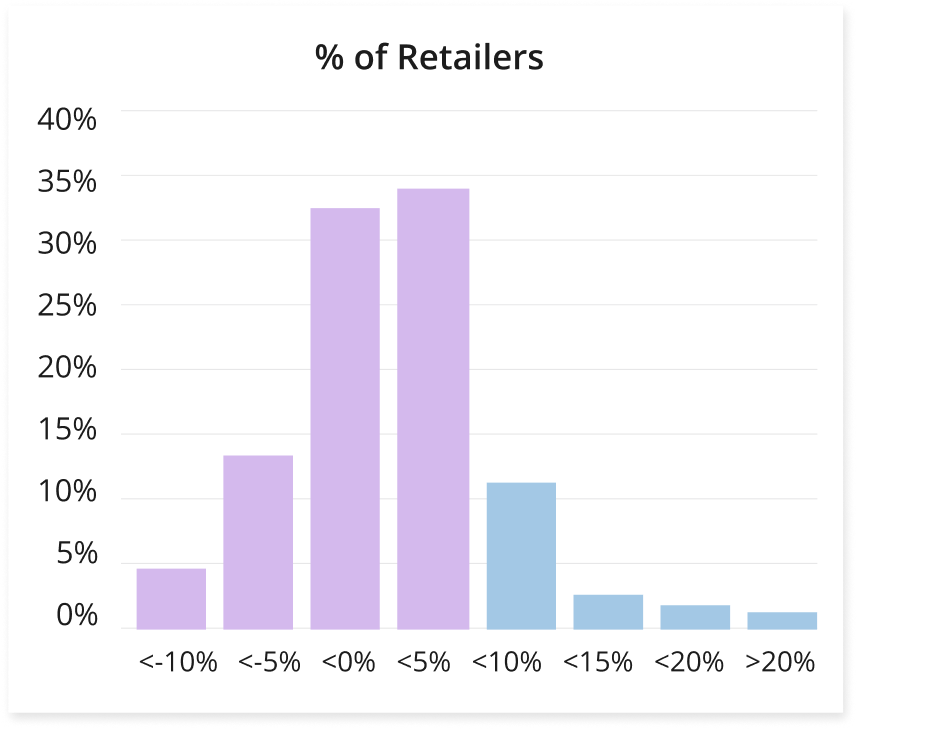
Why 85% of retailers are stuck below
5% profit and how to break free
In an analysis of 120 retailers we did last year, based on 2024 accounts filed at companies house, 85% of
retailers were showing profits under 5%.
With the NI increases, the rise in minimum wage, and
the return to full business rates in April 2025, these
numbers are going to look uglier.
With UK treasuries
yielding 5% who
would want to
invest
in retail.
We are working
with
retailers to get
them
from under 5% to a
minimum of 8% and
then breaking the
10% glass ceiling.
We have what we're calling the GRIP program
We would love to share that with you.

#
28
Do retailers need a customer
director
or a sales director?
In the world, where every
retailer
wants to drive
sales, it does
sometime
baffle me why they
don't have a sales and
marketing
director like
you do in every
other industry.
Historically, retailers have always had separate heads for each of their sales silos; stores, e-commerce and B2B.
But in an Omni channel world where a customer can engage through any channel, surely the only goal is how many customers you win each year, how frequently they shop and what your share of their wallet is. And of
course, how many you can prevent from Lapsing each year.
In the absence of sales and marketing director, who
does the CEO turn to, to define the sales strategy that
will deliver the highest number of customers?
Particularly if you're organised in Silos.
#
29
The productivity crisis in retail and
the need for a great reset
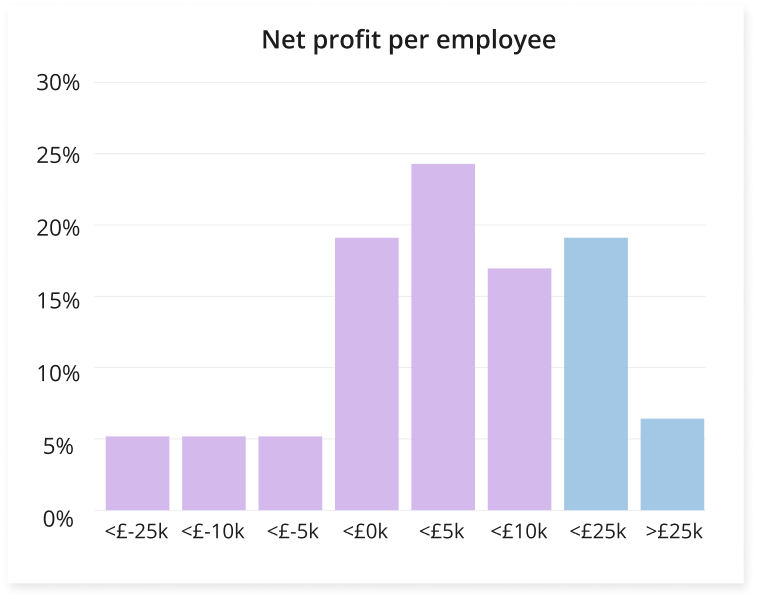
Analysis of company house accounts for 120 retailers,
we found 75% declaring Profits per Head of less than £10,000.
Retail productivity
really sucks.
It is clear the
retailing
industry
needs a step
change in productivity.
That can only come from what we are calling
We need to re-engineer the retail business model away from 20th century structures to deliver the productivity levels needed to make retailing investable again.
#
30
Are retailers truly customer centric?
It is true that retailers
have
always been
product centric.
Everything in a retailer
starts
with a category
or merchandise
plan,
which leads to the
assortment and its execution.
So what does being customer
centric really mean? Jeff Bezos has always maintained
the business model of a retailer should be designed through the eyes of a customer.
Customer centric retailing should serve customer segments and their customers' missions. But how?
In the US the fastest growing retailer is doing precisely that. They are valued at 30x Ebitda. It's a 180 degree
pivot from the current retail business model.
To understand what a customer centric retailer really looks like, please ask us for the blueprint.
#
31
Price says more about a retail
brand
than any other factor
At a Harvard seminar
this
thesis was
presented to me.
If prices are low,
consumers
automatically assume that
the product is low quality,
made from cheap materials,
based on copycat designs, and may not last. That is
certainly the image of fast fashion and as Donald Trump
inferred. 'Tat from China', probably unfairly.
High prices are associated with craftsmanship , high-
quality materials, an investment in design, with the
consumer expecting the product to have a long life.
Price tends to define a brand!
If you keep discounting or get involved in a pricing race
to the bottom, you automatically devalue your brand!
Something to think about.

#
32
The race for market share
As we approach Christmas
the race for market
share
gets intense.
We see retailers
compete
for a
share of the
Customer's
wallet. Sadly, as competition
has increased that race is often
fought by retailers trying to outdo each other on
discounts. Hopefully most of it funded by suppliers.
These strategies of beggar my neighbour are not
sustainable. And I'm not sure they build brand loyalty.
There is a better way.
The retailers that maintain market share are those that
serve customer missions the best. And that should not
always be demonstrated through discounting price.
Evidence shows that mission based marketing always
trump's product marketing in the race for market share.

#
33
Monetising customer
relationships
Is customer data the
crown jewel
in a retailers
valuation?
More and more the
valuation
of a retailer
will be based on
the number of customers they
have, how loyal they are, how
frequently they shop, and their average spend.
Many retailers sell their products on third-party sales
channels like Amazon, Etsy, eBay, next, Deliveroo, etc.
These platforms do not return customer data. They
charge high commissions. Retailers have no control of
these customers. These platforms turn retailers into
product pushers.
For the last 20 years retailers have made Google and
Facebook rich, monetising customer engagement, whilst
their valuations collapsed.
Be wary of outsourcing CRM in any manner, or sharing
customer data with other platforms. It could be
detrimental to your future value.
Platforms that hold customer data will be monetising
them at your expense.
















 Strictly Necessary Cookies
